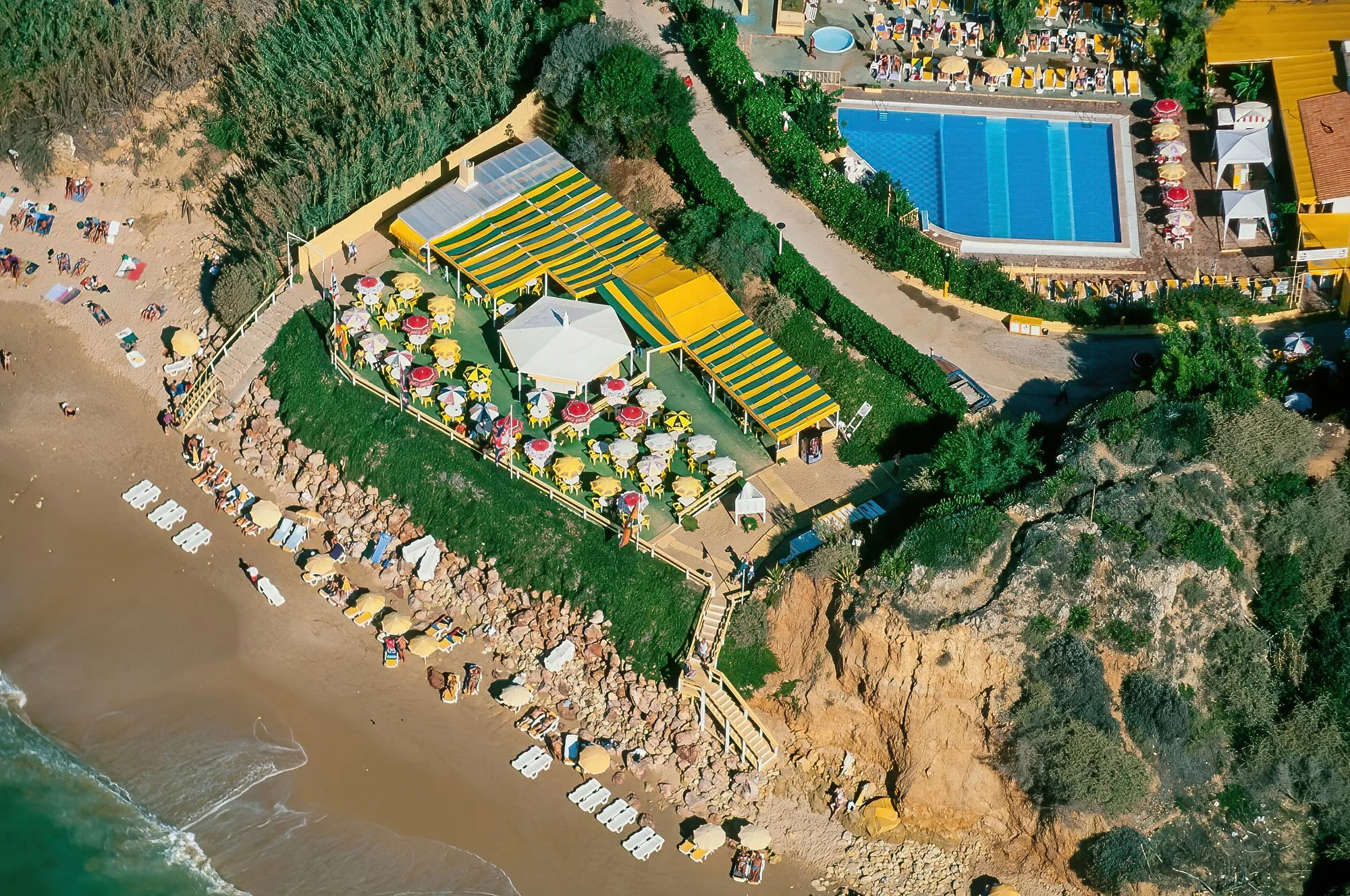
With excellent facilities, gentle climates, and a landscape shaped by wind and sea, Albufeira’s beaches offer something for everyone—lively or serene, social or secluded—capturing the sunny, welcoming spirit that makes the Algarve one of Portugal’s most beloved coastal regions.

Stretching east and west from the old town, the coastline offers an impressive variety of beaches—from lively, urban strands to quiet coves tucked between sculpted rock formations.

At the heart of Albufeira lies Praia dos Pescadores, a vibrant beach framed by whitewashed buildings, cafés, and restaurants. Fishing boats still rest on the sand, blending tradition with the energy of a bustling seaside resort. It’s a place full of life, where swimming, sunbathing, and people-watching come together against a bright blue sea.

The colourful cliffs of the Algarve are one of Portugal’s most striking natural features, shaping a coastline that feels dramatic, sculptural, and endlessly photogenic. Carved by wind and sea, these cliffs rise above the Atlantic in layers of gold, ochre, rust red, cream, and pale limestone, glowing warmly in the southern sunlight.

These steep coastal cliffs define the Algarve’s wild nature. They create a powerful sense of awe and contrast—between solid rock and moving water, height and depth, calm views above and restless seas below—capturing the raw, unforgettable character of southern Portugal’s coastline.

The lighthouse at Ponta da Piedade, near Lagos in Portugal’s Algarve, stands on one of the most spectacular headlands in the country, surrounded by sheer cliffs, carved rock pillars, and the deep blue Atlantic below. Known as the Farol da Ponta da Piedade, the lighthouse occupies a former 16th-century fort, blending maritime history with dramatic natural scenery.

The long, wide beaches stretch along the Algarve coast in broad, sunlit arcs of golden sand, creating a sense of openness that defines this part of southern Portugal.

Along the Algarve coast, the beaches are not just for sunbathing—they are working spaces for traditional fishermen. Fishermen carefully sort their nets, check their gear, and prepare for the day’s work, or return from early trips at sea with the day’s catch.

The water is remarkably clear, shifting from turquoise near the shore to deep sapphire farther out, revealing smooth sand and sometimes even schools of small fish beneath the surface.
Backed by soaring cliffs the beaches of the Algarve feel both picturesque and serene, offering a sense of escape without losing the charm of natural Portuguese coastal life.

Along Portugal’s Algarve coast, the landscape is a dramatic blend of endless sandy beaches and striking cliffs. The beaches stretch for kilometers of golden sand, wide and uninterrupted, giving a sense of space and freedom where the sea meets the sky. This combination of long, open beaches and vibrant cliffs gives the Algarve a unique and unforgettable character

Cabanas de Tavira, often simply called Cabanas, is a tranquil coastal village in Portugal’s eastern Algarve, set along the calm waterways of the Ria Formosa Natural Park. Cabanas feels intimate and unhurried, shaped by fishing traditions and a close relationship with the lagoon rather than the open ocean.

The old fort at Cabanas, known as the Forte de São João da Barra, stands quietly at the edge of the Ria Formosa lagoon, watching over the narrow channel that separates the village from the barrier island beaches. Built in the 17th century, the fort was designed to protect the coast and control access to the lagoon, guarding against pirates and naval attacks along this vulnerable stretch of the Algarve shoreline.

Cabo de São Vicente, near Sagres, is one of Portugal’s most dramatic and symbolic landscapes—a wild promontory where towering cliffs plunge straight into the Atlantic Ocean. Long regarded in ancient times as the edge of the known world.
At the very tip stands the Cabo de São Vicente lighthouse, its solid structure contrasting with the raw landscape around it. For centuries, this point has guided sailors navigating one of Europe’s most treacherous coastlines, and its beam still sweeps the ocean after dark.

The steep cliffs of Cabo de São Vicente mark one of the most dramatic edges of Europe. Here, the land ends abruptly in sheer rock walls that rise high above the Atlantic, plunging straight down into powerful, restless seas.
These cliffs were once believed to stand at the end of the known world, and even today that sense of isolation remains. Standing at the edge, with the Atlantic roaring beneath your feet, the scale of nature feels immense and humbling.

Cabo Espichel is one of Portugal’s most striking and atmospheric headlands, where vast limestone cliffs meet the Atlantic Ocean in a dramatic display of scale and solitude. Located south of Lisbon on the Setúbal Peninsula, the cape feels remote and elemental, shaped by wind, waves, and wide open skies.
Perched dramatically on the cliffs of Cabo Espichel, the Cabo Espichel Lighthouse rises as a white sentinel overlooking the Atlantic Ocean. Its tall, cylindrical tower, crowned with a gleaming lantern, has guided sailors safely along this rugged stretch of coast for centuries

Carvoeiro is a charming coastal town nestled in the Algarve region of southern Portugal, known for its dramatic cliffs, golden beaches, and vibrant village atmosphere. The town’s whitewashed houses and narrow streets spill down towards a small, crescent-shaped beach framed by towering cliffs, giving it a picturesque, postcard-perfect charm.

The coastline around Carvoeiro is one of the Algarve’s most dramatic and scenic landscapes, where towering cliffs meet golden sandy beaches. The cliffs rise steeply from the shore, their orange, red, and ochre hues glowing in the sunlight and forming natural amphitheaters that cradle small, intimate beaches.

Along the Algarve coast near Carvoeiro, the cliffs are pierced by a network of spectacular sea caves and grottoes, formed over millennia by the relentless Atlantic waves. These caves range from small hidden alcoves to grand chambers with high vaulted ceilings, many opening directly onto golden sandy beaches or turquoise waters.

Along the rugged cliffs of Carvoeiro, some of the Algarve’s famous sea caves feature large surface-openings in their roofs, where the Atlantic waves have carved holes through centuries of erosion. These openings allow sunlight to pour into the caves, creating natural skylights that illuminate the golden sands and turquoise waters below.

Visitors can enter the cave by kayak, boat, or swimming, and once inside, the interplay of light, shadows, and the colorful cliffs makes it feel like stepping into a hidden, sunlit chamber sculpted by nature itself.

Spread across the lowlands near the Guadiana River, the Castro Marim salt flats form a striking landscape of geometric pools, pale earthen berms, and mirror-like water surfaces that shimmer under the Algarve sun. These centuries-old salt pans are part of a delicate irrigation and harvesting system that has changed very little since Roman times, relying on gravity, tides, and careful human stewardship.

Rising over the peaceful plains near the Guadiana River, the Fort of Castro Marim—together with the older medieval castle beside it—forms one of the most impressive defensive ensembles in the eastern Algarve. The fort, known as the Forte de São Sebastião, stands on a separate hilltop opposite the ancient castle, its angular bastions and thick stone walls instantly signaling a new era of military engineering shaped by gunpowder and frontier tensions.

Built in the 17th century during the Restoration War, the fort was part of a strategic web of defenses guarding Portugal’s vulnerable border with Spain. Its star-shaped layout, sloped ramparts, and commanding viewpoints were designed not only to withstand cannon fire but to control the vast open terrain and the river approaches below.

Set high on a hill overlooking the wide, quiet sweep of the Guadiana River, Castro Marim Castle is one of the Algarve’s most atmospheric historic strongholds.
Inside the main gate, the castle opens into a broad courtyard framed by ramparts, archaeological remains, and simple stone buildings that hint at centuries of continuous occupation. Romans, Moors, medieval Portuguese kings, and even the Knights Templar all left their mark here

Estoi, a picturesque village in the eastern Algarve, is known for its charming streets, whitewashed houses, and fragrant citrus groves. The village’s centerpiece is the Palace of Estoi a striking 19th-century palace built in the Romantic style. Its soft pink façades, intricate tilework, and elegant balconies give the building a fairytale-like charm.

Surrounding the palace are formal gardens that blend French symmetry with Moorish and English influences. Terraced flowerbeds, shaded pathways, decorative fountains, and elegant statues create a serene and enchanting atmosphere.

Faro’s harbor and marina bring life to the waterfront. Despite being a regional hub, the city maintains a relaxed pace, offering both vibrant cultural experiences and moments of serene reflection. Faro is a place where history, nature, and modern life flow together effortlessly, making it the welcoming heart of the Algarve.

At the heart of Faro’s old town stands Faro Cathedral a majestic symbol of the city’s rich history and spiritual heritage. Originally built in the 13th century on the site of a former mosque, the cathedral reflects layers of architectural styles—from Gothic and Renaissance to Baroque. From the cathedral’s bell tower, one can enjoy sweeping views over the old town, the marina, and the shimmering expanse of the Ria Formosa lagoon.

Ria Formosa, stretching along the coast of Faro, is one of Portugal’s most captivating natural treasures—a shimmering maze of barrier islands, tidal lagoons, salt marshes, and winding sandbanks that constantly shift with the tides and seasons. Protected as a Natural Park, it feels like a world apart from the bustle of the Algarve’s cities and beaches.

Faro, the capital of the Algarve, is a welcoming blend of historic charm, coastal light, and lagoon-side tranquility. Set along the edge of the Ria Formosa, the town feels both peaceful and vibrant, with its old streets unfolding just a short stroll from the shimmering waterways of the natural park. From the city’s waterfront, the Faro marina forms the gateway to this watery labyrinth.

In the early morning light, the sea is calm and the fishing boats begin returning from their overnight trips. The fishermen unload crates brimming with gleaming sardines, silver bream, mackerel, squid, and octopus. In some towns, tractors or old winches help pull the heavier boats up the beach, adding to the rustic charm. Buyers examine the day’s catch and the fishermen call out prices, lift fish for display, and proudly show off the larger specimens.

Cruising along the Guadiana River is a serene way to experience the borderlands between Portugal and Spain, where the river winds through quiet countryside, rolling hills, and traditional villages. The water is often calm and reflective, mirroring the sky and the greenery along its banks, creating a peaceful, almost meditative atmosphere.

A horseman rides along the beach, his horse galloping across the wet sand as waves break nearby. Mane and tail stream in the sea breeze, hooves kick up spray, and the rider moves with effortless control—a timeless scene of freedom, grace, and Portugal’s deep equestrian tradition.

Lagos is a lively town in Portugal’s Algarve, known for its historic old walls, cobbled streets, and whitewashed buildings set close to golden beaches and a bustling marina. With its mix of maritime history, cafés, and coastal charm, it feels both authentic and relaxed.

The Ponta da Piedade Lighthouse is a historic coastal lighthouse perched on the dramatic limestone cliffs of Ponta da Piedade near Lagos in the Algarve region of southern Portugal. It stands as a navigational beacon guiding ships along the rocky stretch of the Atlantic coast and into Lagos Bay.

The beaches of Lagos, Portugal are framed by dramatic golden limestone cliffs that rise steeply above clear turquoise water. Below the cliffs, small sandy coves are tucked between towering rock formations, while the sea has carved out arches, grottoes, and hidden caves. The contrast of rugged cliffs, calm beaches, and sculpted sea caves makes Lagos one of the most striking coastal landscapes in the Algarve.

The Milreu Roman Ruins near Faro, Portugal are the remains of a luxurious Roman villa complex dating from the 1st–4th centuries AD. Once a thriving agricultural estate, the site includes the foundations of a grand residence, thermal baths, and mosaics decorated with geometric and figural motifs. Fragments of columns, walls, and water channels hint at the villa’s original sophistication

Nestled along the stunning Algarve coast, Portimão is a lively seaside city where history, culture, and natural beauty converge.

The beaches of Portimão are among the Algarve’s most spectacular, combining golden sands and crystal-clear Atlantic waters.

The Portimão Bridge, also known as the Bridge over the Arade River, spans the wide estuary near the heart of Portimão in the Algarve. It connects the city with surrounding areas and provides scenic views of the river, the marina, and the city’s waterfront.

The Sagres Lighthouse is situated on the dramatic cliffs of Cape St. Vincent near Sagres, in the Algarve region of Portugal. Overlooking the Atlantic Ocean from one of Europe’s southwesternmost points, it serves as a crucial navigational aid along this rugged and historically treacherous coastline.

The Tavira Salt Flats are a striking natural and cultural landmark located just outside Tavira in the eastern Algarve. These shallow, flat salt pans have been used for centuries to harvest sea salt, a traditional industry that shaped the region’s economy and landscape. Workers, often called “salineiros,” carefully manage the shallow pans, controlling the flow of seawater through a network of channels to allow gradual evaporation under the sun. Once the water has evaporated, salt crystals are raked by hand into small piles and then collected into larger mounds for drying and storage.

Senhora da Rocha is a picturesque coastal village in the Algarve, near Porches, known for its dramatic cliff-top setting overlooking the Atlantic Ocean. The area is famed for the Chapel of Senhora da Rocha, a small historic chapel perched atop a rocky promontory with panoramic ocean views. Below the cliffs lies a charming sandy beach, framed by golden rocks and sea caves, accessible via stone steps carved into the cliffs.

Silves is a historic town in the Algarve, renowned for its rich Moorish heritage and striking red sandstone architecture.

The Silves Castle is a commanding fortress of red sandstone perched atop a hill overlooking the town of Silves and the Arade River in the Algarve. Originally constructed by the Moors in the 8th–10th centuries and later expanded by the Portuguese, it was a key stronghold during the region’s medieval conflicts.

Soccer, or football as it is called locally, is the most popular sport in Portugal, deeply woven into the country’s culture and daily life. From bustling cities to small towns, communities passionately follow local and national teams.

Fishing from the cliffs is a traditional and popular pastime along the Algarve’s rugged coastline. Anglers stand atop the dramatic limestone cliffs that plunge into the Atlantic, casting lines into deep waters where a variety of fish, such as sea bass, mackerel, and grouper, are abundant. The elevated position provides excellent vantage points and access to waters unreachable from the shore.

The Algarve is a top destination for windsurfing, thanks to its consistent winds, warm Atlantic waters, and scenic coastline. Both beginners and experienced windsurfers can enjoy the sport at spots like Alvor, Lagos, and Tavira, where sheltered bays provide calm waters for learning, while open beaches and coastal stretches offer more challenging conditions for advanced riders.

Tavira is a graceful and historic town in the eastern Algarve, known for its calm atmosphere, traditional architecture, and rich cultural heritage. Set along the Gilão River, the town is characterized by Roman bridges, cobbled streets, and whitewashed houses topped with terracotta roofs.

Vilamoura is a luxurious resort town in the central Algarve, renowned for its marina, golf courses, and vibrant leisure facilities. The town’s center piece is the Vilamoura Marina, a hub of upscale restaurants, cafes, and shops, surrounded by luxury yachts and waterfront promenades.

In Vilamoura, the Algarve’s premier resort town, luxury homes are a hallmark of the area, often featuring private swimming pools, landscaped gardens, and modern architectural designs. Nearby, world-class golf courses and tennis clubs attract enthusiasts from around the globe.

The Algarve is one of Europe’s premier golf destinations, renowned for its sunny climate, scenic landscapes, and world-class courses.

Tennis is a popular and growing sport in Portugal, played both recreationally and professionally.